Dialogue on the Threshold

Schwellendialog

28 April 2010

Stultifera navis mortalium


Hi sunt qui descendunt mare in navibus, facientes operationes in aquis
multis. Ascendunt usque ad coelos, & descendunt usque ad abyssos:
anima eorum in malis tabescebat. Turbati sunt & moti
sunt sicut ebrius: & omnis sapientia eorum
devorata est.


They that go down to the sea in ships, that do business in great waters:
They mount up to the heavens, they go down again to the depths:
their soul is melted because of trouble. They reel to and fro,
and stagger like a drunken man, and are at
their wit's end.

25 April 2010

An Tartarus sit aliquid, utrum vero nihil?


Q. An Tartarus sit aliquid, utrum vero nihil?

R. Est aliquid nempe locus cruciatus Luc. 6 [sic.]. Est nihil de quo Plato in Phaedone. Sic ᾅδης est aliquid; ut cum dicitur, descendit ἐις ᾅδην. Est etiam nihil: ut fingitur esse domus Plutonis. Plasmata enim rationis, quae Aristot. opponit πράγμασιν, referimus ad nihil.

Rodolphus Goclenius, Disputatio de nihilo, quae non est de nihilo,
vagans per omnes disciplinas

Q. Whether Tartarus is something or in fact nothing

A. The place of torment is surely something (Luke [16.23]). It is the nothing about which Plato [tells] in the Phaedo. Thus ᾅδης [Hades] is something; as when it is said, he descended ἐις ᾅδην [into Hades]. It is also nothing: as it is imagined to be the house of Pluto. For, the fictions of reasoning, which Aristotle opposed πράγμασιν [to concrete realities], we ascribe to nothing.

Labour sub tecto


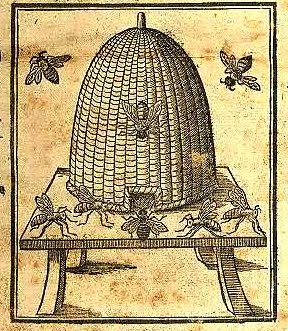
Both S. Basil, and S. Chrysostome put this difference in that place, between the labour of the Ant, and the Bee, That the Ants worke but for themselves, the Bee for others: Though the Ants have a Commonwealth of their own, yet those Fathers call their labour, but private labour; because no other Common-wealths have benefit by their labour, but their own. Direct thy labours in thy calling to the good of the publique, and then thou art a civill, a morall Ant; but consider also, That all that are of the houshold of the faithfull, and professe the same truth of Religion, are part of this publique, and direct thy labours, for the glory of Christ Jesus, amongst them too, and then thou art a religious and a Christian Bee, and the fruit of thy labour shall be Hony. The labour of the Ant is sub Dio, open, evident, manifest; The labour of the Bee is sub Tecto, in a house, in a hive; They will doe good, and yet they will not be seene to doe it; they affect not glory, nay they avoyd it. For in experience, when some men curious of naturall knowledge, have made their Hives of glasse, that by that transparency, they might see the Bees manner of working, the Bees have made it their first work to line that Glasse-hive, with a crust of Wax, they they might work and not be discerned. It is a blessed sincerity, to work as the Ant, professedly, openly; but because there may be cases, when to doe so, would destroy the whole worke, though there be a cloud and a curtaine betweene thee, and the eyes of men, yet if thou doe them clearely in the sight of God, that he see his glory advanced by thee, the fruit of thy labour shall be Honey.

John Donne, Sermon preached at White-hall, 8 April 1621 (Prov. 25.16 Hast thou found honey? Eat so much as is sufficient for thee, lest thou be filled therewith, and vomit it)

15 April 2010

A Dish of Dainties for the Devil


A godly father sitting on a draught,
To do as need and nature hath us taught,
Mumbled (as was his manner) certain prayers,
And unto him the Devil straight repairs,
And boldly to revile him he begins,
Alleging that such prayers are deadly sins;
And that it showed he was devoid of grace,
To speak to God from so unmeet a place.
The reverent man, though at first dismayed,
Yet strong in faith, to Satan thus he said:
"Thou damned spirit, wicked, false and lying,
Despairing thine own good, and ours envying:
Each take his due, and me thou canst not hurt,
To God my prayer I meant, to thee the dirt.
Pure prayer ascends to him that high doth sit,
Down falls the filth, for fiends of hell more fit."

Sir John Harington, A New Discourse of a Stale Subject, Called the Metamorphosis of Ajax (London, 1596), Ed. Elizabeth Story Donno (London, 1974), p. 94 [spelling and punctuation modernised]

09 April 2010

A streame of brimstone


That then there is damnation, and why it is, and when it is, is cleare enough; but what this damnation is, neither the tongue of good Angels that know damnation by the contrary, by fruition of salvation, nor the tongue of bad Angels who know damnation by a lamentable experience, is able to expresse it; A man may saile so at sea, as that he shall have laid the North Pole flat, that shall be fallen out of sight, and yet he shall not have raised the South Pole, he shall not see that; So there are things, in which a man may goe beyond his reason, and yet not meet with faith neither: of such a kinde are those things which concerne the locality of hell, and the materiality of the torments thereof; for that hell is a certaine and limited place, beginning here and ending there, and extending no farther, or that the torments of hell be materiall, or elementary torments, which in naturall consideration can have no proportion, no affection, nor appliablenesse to the tormenting of a sprit, these things neither settle my reason, nor binde my faith; neither opinion, that it is, or is not so, doth command our reason so, but that probable reasons may be brought on the other side; neither opinion doth so command our faith, but that a man may be saved, though hee thinke the contrary; for in such points, it is alwaies lawfull to thinke so, as we finde does most advance and exalt our owne devotion, and Gods glory in our estimation; but when we shall have given to those words, by which hell is expressed in the Scriptures, the heaviest significations, that either the nature of those words can admit, or as they are types and representations of hell, as fire, and brimstone, and weeping, and gnashing, and darknesse, and the worme, and as they are laid together in the Prophet, Tophet, (that is, hell) is deepe and large, (there is the capacity and content, roome enough) It is a pile of fire and much wood, (there is the durablenesse of it) and the breath of the Lord to kindle it, like a streame of Brimstone, (there is the vehemence of it:) when all is done, the hell of hels, the torment of torments is the everlasting absence of God, and the everlasting impossibility of returning to his presence.

John Donne, sermon Preached to the Earle of Carlile and his company, at Sion [? 1622], Mark 16:16 "He that beleeveth not, shall be damned"


Fresco in the porch of the Church of St. Nicholas - Udricani (1735), Bucharest

01 February 2010

Dorotheos of Gaza on encystment within the passions


Doctrina XII, De timore et poenis inferni (Migne, Patrologia Graeca, 88, 1752)

Through the body, the soul is distracted from its passions and is comforted, it eats, drinks, lays itself down to rest, keeps company, finds diversion in loved ones. But when it goes out of the body, the soul remains alone with its passions, and ultimately it is tormented by them forever, dwelling upon them, consumed with their agitation, rent asunder by them, so that it is no longer able to remember God. For remembrance of God comforts the soul, as it says in the psalm: I remembered God and was gladdened [Ps. 76:4]. But the passions do not allow the soul even this. Will you learn by a parable what it is I say? Let one of you go and shut himself up alone in a dark cell, and for three days let him not eat, drink, lay himself down to rest, meet anyone, sing psalms, pray, or remember God in any wise. Then shall he learn what the passions do to him. And this while he is yet here, but how much more so after the soul goes out of the body, and will have given itself up to the passions and will be alone with them.

21 January 2010

Infinitely less than nothing


That great Library, those infinite Volumes of the Books of Creatures, shall be taken away, quite away, no more Nature; those reverend Manuscripts, written with Gods own hand, the Scriptures themselves, shall be taken away, quite away; no more preaching, no more reading of Scriptures, and that great School-Mistress, Experience, and Observation shall be remov'd, no new thing to be done, and in an instant, I shall know more, than they all could reveal to me. I shall know, not only as I know already, that a Bee-hive, that an Ant-hill is the same Book in Decimo sexto, as a Kingdom is in Folio, That a Flower that lives but a day, is an abridgment of that King, that lives out his threescore and ten yeers; but I shall know too, that all these Ants, and Bees, and Flowers, and Kings, and Kingdoms, howsoever they may be Examples, and Comparisons to one another, yet they are all as nothing, altogether nothing, less than nothing, infinitely less than nothing, to that which shall then be the subject of my knowledge, for, it is the knowledge of the glory of God.

John Donne, from A Sermon preached at the Spittle, upon Easter-Monday, 1622

04 January 2010

Hê thlipsis hê aporrhêtos


As to those that fall away from God, I wonder where it is they exist, those that are far removed from Him that is everywhere, and verily, O brothers, is it a wonder full of great trembling, one that requires the reasoning of an illumined mind,


in order properly to understand this thing and not to fall into heresy as a result of ignorance of the words of the Holy Ghost. They, too, will wholly have existence within the universe, but outside of the divine light and even outside of God.


For, just as those that cannot see the shining sun, although they are wholly bathed in its light, end their days outside of the light, severed from any sense or sight of it, so too in this universe is the divine light of the Trinity,


and in its midst the sinners that are enclosed in darkness, unseeing, bereft of any divine sense, but consumed and chastised by their conscience, will know for all eternity unspeakable affliction and ineffable pain.


St. Symeon the New Theologian, Hymns, I, 215-231


(English translation: Alistair Ian Blyth)


03 January 2010

Two sub-hells: Nyôfunjo and Nôketsujo


Depiction of the torments of the damned in the Buddhist sub-hell of Nyôfunjo (Dung Pit), or the shifunsho (place of excrement), one of the paintings in the Jigokuzôshi (Illustrated Stories of Hell) found in a Heian period (794-1185) emakimono (picture scroll) kept in the Nara National Museum ("Genkahon"; height 26.66 cm, length 433.42 cm). The text of the emakimono describes the sins and the torments of those who wallow in the Dung Pit as follows:
While these men lived, they considered dirty what in reality was not; they also considered clean what was not, due to the foolishness of their heart. (...) The pit in which they are is deep, and they are sunk in it up to their necks; it smells very bad there. This filth is beyond comparison with anything of this world, and the pains of the damned are unbearable.

(translated by Fernando G. Guttiérez, "Emakimono Depicting the Pains of the Damned," Monumenta Nipponica, Vol. 22, No. 3/4 (1967), p. 285)
The scroll also illustrates the sub-hell called Nôketsujo (Place of Pus and Blood):


Those who suffer eternal anguish therein are said to have been of foolish heart and wicked intent during their lives, and to have forced others to eat filthy things:
This is why they are in hell now. An enormous amount of pus fills this place up to the mouth and nose of the damned. There are also terrible insects called Saimôshô that devour the damned to the marrow of their bones, and break their tendons. It is impossible to describe how terrible this pain is.

(translated by Fernando G. Guttiérez, "Emakimono Depicting the Pains of the Damned," Monumenta Nipponica, Vol. 22, No. 3/4 (1967), p. 286)

02 January 2010

Irremediableness


I fall sick of Sin, and am bedded and bedrid, buried and putrified in the practise of Sin, and all this while have no presage, no pulse, no sense of my sicknesse; O heighth, O depth of misery, where the first Symptome of the sicknes is Hell, and where I never see the fever of lust, of envy, of ambition, by any other light, than the darknesse and horror of Hell it selfe; and where the first Messenger that speaks to me doth not say, Thou mayest die, no, nor Thou must die, but Thou art dead: and where the first notice, that my Soule hath of her sicknes, is irrecoverablenes, iremediablenes.

John Donne, Devotions upon Emergent Occasions (1624), Expostulation 1

24 November 2009

The bees of the invisible


Wir sind die Bienen des Unsichtbaren. Nous boutinons éperdument le miel du visible, pour l'accumuler dans la grande ruche d'or de l'invisble.

Rainer Maria Rilke to his Polish translator, Witold von Hulewicz,
13 November 1925 (Briefe aus Muzot, 1921-26)


The bee-swarm of the dead drones and comes upwards

Sophocles, fr. 795, Porphyr. de antro nymph. c. 18
(August Nauck, Tragicorum Graecorum Fragmenta, 2nd edition, Leipzig: Teubner, 1889, p. 317)


18 November 2009

Speculation on debasement: philosophies of "nothing but"

The last and lowest region of the Bardo [is] known as the Sidpa Bardo, where the dead man (...) begins to fall a prey to sexual fantasies and is attracted by the vision of mating couples (...) Freudian psychoanalysis, in all its essential aspects, never went beyond the experiences of the Sidpa Bardo; that is, it was unable to extricate itself from sexual fantasies and similar ‘incompatible’ tendencies which cause anxiety and other affective states (...) anyone who penetrates into the unconscious with purely biological assumptions will become stuck in the instinctual sphere and be unable to advance beyond it, for he will be pulled back again and again into physical existence. It is therefore not possible for Freudian theory to reach anything except an essentially negative valuation of the unconscious. It is a ‘nothing but’.

Carl Gustav Jung, Collected Works. Psychology and Religion: West and East, 2nd edition, 1966, pp. 515-516


“Materialism is the reduction of any higher form to its lower matter. Materialism tells us that organic life can be reduced to physicochemical processes, that humans are in essence only animals, that consciousness is only a neural network. Materialism tells us that the statue is only marble, that music is only a sound wave. But materialism will also tell us, in exactly the same way, that culture is only a particular form of the economy (“economic materialism”), that spirit is only a particular form of the basic sexual energy, as Freud has done (...) A downward movement through the levels explains nothing: the movement must go upward. But as soon as we say: “not only, but also,” we can immediately run through the hierarchy of levels from bottom to top: “not only marble, but also a form of beauty,” “not only a sound wave, but also harmony,” “not only nature, but also freedom,” “not only the processes of consciousness, but also the creative spirit,” and, finally, “not only relative but also absolute.” Here is the ascent that Marxism cannot accept, for it leads to the Absolute Spirit, it ascends to the absolute summit, to the sublime God himself. The opposite path leaves us only with speculation on debasement: always to say “only”, always to reduce every form to lower matter.

B. P. Vysheslavtsev, The Eternal in Russian Philosophy, trans. Penelope V. Burt, Wm. B. Eerdmans, 2002, pp. 67-68

The Cockroach in Russian Literature (1): Gogol

Надобно вам знать, милостивый государь, что я имею обыкновение затыкатьна ночь уши с того проклятого случая, когда в одной русской корчме залез мне в лебое ухо таракан. Проклятые кацапы (1), как я после узнал, едят даже щи с тараканами. Невозможно описать, что происходило со мною: в ухе так и щекочет, так и щекочет ... ну, хоть на стену! Мне помогла уже в наших местах простая старуха. И чем бы вы думали? просто зашептыбанием.

Н. В. Гоголь, "Иван Федорович Шпонька и его тетушка", Собрание сочинений, том первый, Художесвенная литература, Москва, 1976, стр. 184


You ought to know, dear sir, that I'm in the habit of stopping up my ears at night, ever since that damned incident at a Russian inn when a cockroach crawled into my left ear. Damned goat-beard Russians, as I later discovered, they even eat cabbage soup with cockroaches in it. It defies description what happened to me: it kept tickling and tickling away in my ear ... well, I was on the point of banging my head against the wall! It was a simple old woman from around our way that helped me in the end. And how do you think she did it? Simply by whispering.


N. V. Gogol, "Ivan Fyodorovich Shpon'ka and His Aunt"


(1) кацап, укр. прозвище великорусов (Гоголь и др.). С приставкой ка- от укр. цап "козел" : бритому украинцу бородатый пусский казался козлом. (Max Vasmer, Russisches Etymologisches Wörterbuch, Heidelberg, 1950-1958. Макс Фасмер, Этимологический словарь русского языка, Перевод с немецкого и дополнения члена-корреспондента РАН О. Н. Трубачева, Том II (Е-Муж), Издательство Азбука, Санкт-Петербург, 1996, стр. 213.)

Cf. H. Tiktin, Rumänisch-deutsches Wörterbuch, vol. 3, Staatsdruckerei, Bucharest, 1925, p. 1557: țap sm. 1. (Ziegen-, auch Gems-) Bock m. Barba ... foarte pe jos pe supt bărbie ca de țap (Gaster, Crestomatie romînă) (...) Fam. scherzh. verträumt: ca un țap logodit vertraümt: Ce te uiți așa la mine ca un țap logodit? Poate-i fi amorezat (Sadoveanu). (...) - 2. Spottname a) für Griechen, wegen ihrer Gesischtzüge. Ho, țapule, că mai sînt și eu pe-aici (Alecsandri). (...) - b) für Geistliche u. Mönche, wohl wegen ihrer Bärte. Sînt vr'o zece mii de țapi cu călugărițe cu tot în țară (Jipescu). (...) Et. Vgl. alb. skjap, ts(j)ap, tskjap. Nslov. serb. poln. cap, czech. magy. cáp stammen aus dem Rum.

16 November 2009

Stimmung


Da sind Tage, wo alles um einen licht ist, leicht, kaum angegeben in der hellen Luft und doch deutlich. Das Nächste schon hat Töne der Ferne, ist weggenommen und nur gezeigt, nicht hergereicht; und was Beziehung zur Weite hat: der Fluß, die Brücken, die langen Straßen und die Plätze, die sich verschwenden, das hat diese Weite eingenommen hinter sich, ist auf ihr gemalt wie auf Seide. Es ist nicht zu sagen, was dann ein lichtgrüner Wagen sein kann auf dem Pont-neuf oder irgendein Rot, das nicht zu halten ist, oder auch nur ein Plakat an der Feuermauer einer perlgrauen Häusergruppe. Alles ist vereinfacht, auf einige richtige, helle plans gebracht wie das Gesicht in einem Manetschen Bildnis. Und nichts ist gering und überflüssig. Die Bouquinisten am Quai tun ihre Kästen auf, und das frische oder vernutzte Gelb der Bücher, das violette Braun der Bände, das größere Grün einer Mappe: alles stimmt, gilt, nimmt teil und bildet eine Vollzähligkeit, in der nichts fehlt.

Rainer Maria Rilke, Die Aufzeichnungen des Malte Laurids Brigge (1910)


03 November 2009

La révélation


Je crois et avec foi, peut-être que comme la vue en rêve d'une personne est, à certains points de vue, une preuve de sa réalité métaphysique, la révélation est sur les mêmes points la preuve de la réalité métaphysique de certains hasards qui nous arrivent par moments ; de la façon, de la disposition dont quelquefois des choses se présentent et réveillent en nous des sensations inconnues de joie et de surprise : les sensations de la révélation.

De Chirico

02 October 2009

Regressionstendenzen


Ach, nie genug dieses einen Erlebnisses: das Leben währet vierundzwanzig Stunden und, wenn es hoch kommt, war es eine Kongestion! Ach immer wieder in diese Glut, in die Grade der plazentaren Räume, in die Vorstufe der Meere des Urgesichts: Regressionstendenzen, Zerlösung des Ich! Regressionstendenzen mit Hilfe des Worts, heuristische Schwächezustände durch Substantive – das ist der Grundvorgang, der alles interpretiert: Jedes ES das ist der Untergang, die Verwehbarkeit des Ich; jedes DU ist der Untergang, die Vermischlichkeit der Formen. ‘Komm alle Skalen tosen Spuk, Entformungsgefühl’ - das ist der Blick in die Stunde und die Glücke, wo die ,Götter fallen wie Rosen’ - Götter und Götterspiel. Schwer erklärbare Macht des Wortes, das löst und fügt.

Gottfried Benn, Lyrisches Ich (1927)


28 September 2009

Нос / Nez / Nas / Nose


Le mal n'est donc pas une simple absence (...) c'est un mélange de l'être et du non-être. Toutes les manifestations du Malin dans le monde sont conditionnées par les trois formes de son essence : il est parasite, imposteur et imitateur, faisant du monde une parodie du Royaume. Le récit intitulé le Nez nous apporte une claire démonstration de cette triple nature. En effet le Mal se sert du nez comme d'un point d'attache parasitaire. En devenant le double du major Kovalev, il usurpe quelque chose de sa personne en véritable imposteur qu'il est. Enfin, en prenant possession de la Cathédrale de Saint-Pétersbourg, il imite et parodie Celui qui est le Maître du Temple.

Paul Evdokimov, Gogol et Dostoïevski. La descente aux enfers, Desclée de Brouwer, 1961


10 September 2009

Epistola obscuri viri (Malbrough theme 3)


Herbordus Mistladerius Magistro Ortvino incomparabili in doctrina praeceptori suo sulsissimo Salutem dicit quam nemo dinumerare poterit

Illuminatissime magister, quando discessi a vestra dominatione ad Suollis ante duos annos, promisistis mihi ad manum meam quod velitis mihi frequenter scribere, et mihi modum dare dictandi in vestris dictaminibus: ast non facitis, et mihi non scribitis sive vivitis, sive non vivitis; sive vivitis sive non vivitis, non tamen scribitis ut scio quid est, quomodo vel qualiter est. Sancte deus, quomodo me sollicitatis: rogo vos propter deum et sanctam Geogium [sic.], liberate me ex mea cura, quia timeo quod caput vobis dolet, vel quod habetis infirmitatem in ventre, et estis laxus, sicut olim fuistis quando permerdastis caligas vestras in plateis et non sensistis, donec una mulier dixit: "Domine magister, ubi sedistis in merdis? ecce tunica et pantofoli vestri sunt maculata": tunc ivistis in domum domini Ioannis Pfefferkorn, et mulier eius dedit vobis alia vestimenta: vos debetis comedere ova dura, et castaneas in fornace assatas, necnon fabas coctas aspersas cum papavere, ut fit in Westvalia patria vestra. Mihi somniavit de vobis quod habetis gravem tussim, et multum de flegmate: comedite zuccarum, et pisas contusas mixtas cum serpillo et allio contrito, ac ponite unum assatum caepe ad umbilicum vestrum, et per sex dies debetis abstinere a mulieribus; tegite caput et lumbos vestros bene, et sanabitis. Vel sumite receptum quod uxor domini Ioannis Pfefferkorn saepe languentibus dederat, quod est probatum saepe. Ex Suollis.

Epistolae Obscurorum Virorum, I, 40.

03 September 2009

The Digestionary Theory of Literary Genre


On pourrait ranger (...) le genre humain civilisé en trois grandes catégories : les reguliers, les resserrés et les relâchés. (...) Pour me faire comprendre par un exemple, je le prendrai dans le vaste champ de la littérature. Je crois que les gens de lettres doivent le plus souvent à leur estomac le genre qu’ils ont préférablement choisi. Sous ce point de vue, les poètes comiques doivent être dans les réguliers, les tragiques dans les resserrés, et les élégiaques et pastoureaux dans les relâchés : d’ou il suit que le poète le plus lacrymal n’est séparé du poète le plus comique que par quelque degré de coction digestionnaire.

[Brillat-Savarin.] Physiologie du goût, ou méditations de gastronomie transcendante, Ouvrage théorique, historique et à l’ordre du jour. Paris: Charpentier, Éditeur, 1838. P. 231 "Influence de la digestion"


One might separate civilised human kind into three broad categories: the regular, the constipated and the lax. (...) In order to make myself understood, I shall take an example from the vast field of literature. I believe that men of letters for the most part owe their preferred choice of genre to their stomach. From this point of view, the comic poets are to be found among the regular, the tragic poets among the constipated, and the elegaic and pastoral poets among the lax: whence it follows that the most lachrymose poet is separated from the most comic poet only by a degree of digestionary coction.

30 August 2009

De Chirico on the Surrealists

Les surréalistes

Poco dopo esser giunto a Parigi trovai una forte opposizione da parte di quel gruppo di degenerati, di teppistoidi, di figli di papà, di sfaccendati, di onanisti e di abulici che pomposamente si erano autobattezzati surrealisti e parlavano anche di "rivoluzione surrealista" e di "movimento surrealista". Questo gruppo di individui poco raccomandabili era capeggiato da un sedicente poeta che rispondeva al nome di André Breton ed il quale aveva come aiutante di campo un altro pseudo-poeta di nome Paul Eluard, che era un giovanottone scialbo e banale, con il naso storto e una faccia tra di onanista e di cretino mistico. André Breton, poi, era il tipo classico del somaro pretenzioso e dell'impotente arrivista.

Memorie della mia vita, Astrolabio, Rome, 1945

De Chirico

Shortly after arriving in Paris I encountered strong opposition on the part of that group of degenerates, hooliganoids, spoiled brats, meddlers, onanists and idlers that had pompously baptised themselves surrealists and even talked about a "surrealist revolution" and a "surrealist movement". That group of unsavoury individuals was led by a self-styled poet who answered to the name of André Breton and as his second-in-command he had another pseudo-poet by the name of Paul Eluard, who was a pasty, dull young man, with a crooked nose and a face between that of an onanist and a mystical cretin. André Breton, besides, was the classic type of the pretentious ass and the impotent self-seeker.

André Breton

20 August 2009

Stimmung


Cette nouveauté est une poésie étrange et profonde, mystérieuse et solitaire infiniment, qui se base sur le stimmung (j'use de ce mot allemand car il dit bien ce qu'il veut dire ; on pourrait le traduire par le mot atmosphère, pris dans le sens moral), qui se base, dis-je, sur la stimmung d'un après-midi d'automne quand le ciel est clair e les ombres plus longues que pendant l'été, car le soleil commence à être plus bas.


Soudain tout ce plein air perdit son atmosphère, sa stimmung ; les poutres du plafond et les lames du plancher apparurent violemment éclarées de côté ;
--> « c'est un truc du photographe du pays », chuchotait-on dans les cafés et sur les places publiques.


« Mes chers amis, vous avez probablement senti, aussi bien que moi, la stimmung (atmosphère) toute particulière qui se dégage lorsque sortant dans les rues, vers le coucher du soleil, à la fin d'une chaude journée d'été, après avoir dormi pendant l'après-midi (rappelez-vous ce que je vous ai dit, plusiers fois déjà, à propos du sommeil de l'après-midi) on sent l'odeur des rues fraîchement arrosées. Si la ville est située au bord de la mer, la puissance suggestive de cette odeur se trouve par le fait même doublée et même triplée. »
Giorgio de Chirico

19 August 2009

Bacovia, Melancholy, Stimmung

George Bacovia (1881–1957) is widely regarded as having been one of the most important Romanian poets of the twentieth century. Although his work has its origins in and draws much of its imagery from late Symbolism, Bacovia was a modernist whose work bears comparison with the poetry of German expressionism. The poetry of George Bacovia might also be defined in terms of Stimmung, a term employed by Hegel, Schopenhauer and Nietzsche to designate atmosphere in the moral or lyric sense: the inter-penetration of subjective mood and the atmosphere immanent in the external setting. The mood that is evoked in Bacovia’s work is one of isolation, neurosis, lovelessness, despair, and existential anguish. It is a subjective state that simultaneously permeates and is exuded by his poetry’s décor of muddy, provincial streets, pluvial autumn weather, deserted municipal parks, claustrophobic salons, railway sidings, abattoirs, ramshackle slum dwellings, cemeteries, and insalubrious taverns. The boards of this eerie, expressionist stage set are trodden by a cast of consumptives, suicides, alcoholics, madmen, funeral processions, the sniggering ghosts of Poe and Rollinat, and the alienated, anguished persona of the poet himself, assailed by disembodied voices boding imminent self-annihilation.

In spite of the theatrical intensity of his poetry, Bacovia’s life can be said to have been unspectacular. Although he lived through two world wars and a period of social and political upheaval, his biography is singularly lacking in incident. He was born Gheorghie Vasiliu in the Moldavian town of Bacău, which was to provide him with the pseudonym ‘Bacovia’ as well as the bleak provincial setting of much of his poetry. His entire adult life he was to be afflicted by ill health and chronic depression, which led to a number of nervous breakdowns and hospitalisation. His poor health and nervous condition also meant that he was unable to practise as a lawyer, the profession for which he had studied, with frequent interruptions, from 1903 to 1911. Instead, he led a reclusive, solitary life, eking a living variously as a clerk, supply teacher, and librarian.

Bacovia published his first poem, ‘Și toate’ (‘And All’) in 1899 in Literatorul, a review edited by flamboyant Romanian symbolist poet Alexandru Macedonski (1854-1920). The poem, which concludes with the line “In my heart it is autumn”, is in itself unremarkable and, if anything, a cliché typical of the period. Notably, the year it appeared also saw the publication of the last, autumnal works of the crepuscular ‘decadent’ movement in European literature, including Ernest Dowson’s Decorations and Jean Moréas’ Les Stances. The 1890s, as Ezra Pound once put it, were a period of putrescent ‘muzziness’ (1), preliminary to that radical change in human nature which Virginia Woolf identified as having occurred “on or about December 1910”.(2) However, despite his fin-de-siècle debut, Bacovia’s first collection of poems, entitled Plumb (Lead), was not published until 1916, and was contemporaneous not only in date but also in its innovation with major modernist texts such as Ezra Pound’s Lustra and Gottfried Benn’s Gehirne. Plumb earned widespread critical praise in Romania for its originality, although it would take many decades before Bacovia’s radical newness was fully appreciated or understood. Having said that, Bacovia was compared early on to major expressionist poet Georg Trakl (1887-1914) (3), whose posthumous Sebastian im Traum had been published the year before Plumb. However, after Plumb, the work that established Bacovia’s reputation, other volumes of poetry followed only intermittently: Scîntei galbene (1926) (Yellow Sparks), Cu voi… (1930) (With you…), Comedii în fond (1936) (Comedies After All), Stanțe burgheze (1946) (Bourgeois Stanzas). Scîntei galbene and Cu voi… still included poems that had been written decades previously, in the late 1890s and the first decade of the twentieth century, thus producing a somewhat deceptive impression of Bacovia’s development as a poet. However, as is evident in his last published collection, Stanțe burgheze, Bacovia’s later style, which reduces verse form to elliptical, almost telegraphic utterances, is radically different from his youthful ‘symbolism’.

In the early years of the communist regime, Bacovia was viewed with official disapproval as a “decadent”. Between 1948 and 1949 he briefly held a sinecure as an adviser to the People’s Theatre in Bucharest, but the post was abolished and he subsequently entered a period of protracted obscurity. Publication of his work was officially blocked until 1956, the year in which he published three poems in two separate periodicals as well as a new collection of his pre-war poetry. In the same year, the communist state, which had decided to exploit Bacovia for his propaganda value as a ‘proletarian poet’ (4), awarded him the “Order of Labour”. The attitude of Bacovia himself to his new-found celebrity was typically ambiguous and ironic, as is evident in a poem entitled ‘Festiva’, written on the occasion of the official celebrations to mark his seventy-fifth birthday, but not published until 1961 (5):
Da, fusei în castelul
Nababilor
Cu cristale, oglinzi și marmoră…

Iată! Am venit ca Hamlet
În hainele mele
Cernite.
“Yes, I was in the castle / Of the nabobs / With crystal, mirrors and marble … // Look! I arrived like Hamlet / In my inky garb.”
When he died the following year, the reclusive poet was honoured with an official funeral ceremony, which was attended by state dignitaries.

****

Bacovia’s early critics regarded him as a minor, provincial poet and pointed to what they saw as his primitivism, describing his poetry as an authentic, albeit naïve, outpouring of raw emotion. For example, in an article published in 1916, representing one of the earliest critical reactions to Plumb, N. Davidescu interprets Bacovia’s poetry as being unaffectedly ‘sincere’. The poems in Plumb would thus represent a raw, unpolished proto-poetry, an expression of the “elementary stirrings of life, impulsively manifested through cries of pain, surprise, sadness.”(6)

The supposed ‘primitivism’ of George Bacovia’s work might be discovered even in the physical appearance of his books as objects, with their low quality paper and shoddy typography. Critic Vladimir Streinu, in particular, was appalled by the shabby aspect of Bacovia’s printed works: “All his volumes are squalid in appearance, so squalid in fact that the reader is even put off opening them… The second, third and fifth collections are truly repugnant in appearance.”(7) He contrasts this with the evident penchant of other, more pretentious, poets for elegant deluxe editions.

On the other hand, the physical neglect evident in the volumes that were published subsequent to Plumb is the natural and tangible manifestation of a “declining talent”, what Streinu defines as “resignation of spirit and moral regress”. However, although he recognises that the reading public would probably scoff at such a claim, Streinu is quick to affirm that Bacovia is a poet unique not only in Romanian letters but also in the context of universal literature. In spite of the fact that his poetic line often fails to achieve full articulation, George Bacovia is, Streinu argues, a profoundly suggestive poet, whose originality lies in his exploration of the process whereby consciousness tends to extinction and is reduced to a physiological state, a process of involution, of collapse that attains the primary state of matter.(8) In this context, we might compare Bacovia to Gottfried Benn, in whose poetry the agony provoked by the world of consciousness (Bewußtseinswelt) brings about the urge to regress to the primitive, ‘deforeheaded’ (entstirnt) condition of protoplasm. Certainly, in many of Bacovia’s poems the ‘primitive’ and the ‘barbarous’ threaten to overwhelm with elemental madness the enervated consciousness of the lyric ‘I’, such as in ‘Plouă’ (‘It’s Raining’), collected in the volume Plumb:
Oh, plînsul tălăngii cînd plouă!

Și ce enervare pe gînd!
Ce zi primitivă de tină!
O bolnavă fată vecină
Răcnește la ploaie rîzînd…

Oh, the sobbing of cowbells when it rains! // And such enervation of thought! / Such a primitive day of clart! / A sickly girl from next door / Is yelling at the rain laughing…
In ‘Seara tristă’ (‘Sad Evening’), for example, whose setting might be compared with Gottfried Benn’s ‘Nachtcafe’ (in the volume Fleisch, 1917), it is the ‘barbarous’ singing of a woman to the accompaniment of zithers that threatens to obliterate the intoxicated, fragile awareness of the poet. Ultimately, the poetry of Plumb is not so much the expression of a primitive awareness as that of an exacerbated self-consciousness whose hypertrophy now threatens collapse and regression to animal oblivion.

Later critics have tended to interpret Bacovia’s poetry in precisely the opposite terms to primitivism, emphasising its artificiality and almost hysterical theatricality. In Istoria literaturii române de la origini pînă în prezent (1941) (The History of Romanian Literature from its Origins until the Present), George Călinescu dismisses earlier interpretations of Bacovia as a provincial primitive: “It is curious that the poetry of Bacovia has been regarded as lacking in any poetic artifice, as a poetry that is simple and artless. For it is precisely its artifice that strikes one and ultimately constitutes its worth.”(9) Indeed, Bacovia’s work is highly stylised: the obsessive repetition of a limited number of words, images and tropes creates a monotonous, claustrophobic and almost hallucinatory effect. The seeming lack of artifice is in fact a highly artificial construct that is a response to a profound crisis of language and spirit.

Like Georg Trakl, the great modernist poet with whom he was contemporary, George Bacovia is an autumnal poet. The autumn of the modernists is, however, no ‘season of mists and mellow fruitfulness’, but rather a state of spiritual and historical crisis. It is a dissonant, dyspnoeic fugue, in which world, language and self enter into putrefaction and ultimately cave in on themselves. Certainly, in the poetry of Bacovia, autumn is the manifestation of a generalised malady, which affects mind, body and world. In this context, his work is notable for the frequent occurrence of neologisms drawn from medical and psychiatric terminology: a delira, delir, (French délirer, délire); a enerva (French énerver); a histeriza, histerie, (French hystériser, hystérie); nevroză (French névrose); paralizie (French paralysie); ftizie (French phtisie). Striking in this category is the term alcoolizat (‘alcoholised’), the past participle of a verb derived from the French alcoolizer. When, in ‘Nervi de toamnă’ (‘Autumn Nerves’), Bacovia imagines himself as an “alcoholised skeleton” lost in the rain, he does not, therefore, refer to a temporary state of inebriation, but rather to a chronic medical syndrome, that of physiological saturation with alcohol as a result of protracted abuse. Existential states become identical and interchangeable with chronic medical conditions. Nature, or rather the urban landscape, also manifests the symptoms of chronic ailment: a garden is “gangrened” (‘Poem in the Mirror’); a park is “consumed by cancer and phthisis” (‘In the park’); the town is “paralysed” (‘Autumn Notes’).

Spiritual crisis is also evident in the secularisation of external reality in Bacovia’s poems. In Plumb, for example, a park is given precisely the epithet ‘secular’ (‘Décor’), while elsewhere the snow is described as falling “secularly” (‘Winter Lead’). In the poem ‘Yellow Sparks’, from the volume of the same name, a “positivist voice” wakes the poet at a “melancholic window”, while in ‘Ballet’ white ballerinas mysteriously arouse “the organic complex”. This secularisation (or de-sacralisation) of reality is ultimately part of a process whereby humans themselves become reified: “man has become concrete” (‘Winter Lead’, in the volume Yellow Sparks).

Although man, nature and abstract qualities become reified, are reduced to things, the poems of Bacovia themselves are eerily devoid of concrete things. In the volumes Lead (1916) and Yellow Sparks (1926) the world becomes a bare stage set, like the “large, empty salon” where the histrionic action of the poem ‘Marche Funèbre’ takes place. Such objects as do appear acquire almost the function of theatrical props or costume: a coffin, an armchair, a large oval mirror, a handkerchief, funeral vestments and so on. Other things are not physically present except insofar as they are able to produce a sound effect from off-stage: the mournful clank of cowbells in the distance, a military bugle from the barracks at the edge of town, or a primaeval alpenhorn booming from the depths of a remote valley. Everywhere there is a neurasthenic hypersensitivity to sound: branches scraping against roofs, creaking woodwork, and, ubiquitously, the sound of the falling rain.

Otherwise, the world of things is reduced to amorphous, indeterminate ‘matter’, which impinges upon the awareness acoustically rather than visually or tactilely: “I hear matter weeping” (‘Lacustrine’). Similarly, colour becomes an acoustic rather than visual quality. This is nowhere more evident than in the obsessive repetition of the colour epithet ‘violet’ in numerous poems. Bacovia frequently employs the word ‘violet’ purely for its synaesthetic quality, a combination of colour, odour and sound, such as in the following lines, from ‘Nervi de Primavara’ (‘Spring Nerves’):
Primăvară…
O pictură parfumată cu vibrări de violet,
În vitrine, versuri de un nou poet;
În oraș suspină un vals în fanfară.

O nouă primăvară de visuri și păreri…

Spring… // A picture perfumed with violet vibrations, / In shop windows, verses by a new poet, / In town the brass band sobbing of a waltz. // A new spring of vagaries and views…
As the phrase “violet vibrations” and the obsessive alliteration of the consonant ‘v’ might suggest, the adjective ‘violet’ is primarily acoustic rather than chromatic. Of course, the adjective ‘violet’ and alliteration of the consonant ‘v’ situate Bacovia within a Symbolist tradition of melic language that can be traced back to Edgar Allen Poe’s poem ‘The City in the Sea’ and its line: “The viol, the violet and the vine.” For example, the word ‘violet’ also occurred repetitively in the work of English decadent poet Ernest Dowson, who held that that ‘v’ was the most beautiful sound and regarded his poetry as mere “sound verse, with scarcely the shadow of a sense in it”.(10) In the nineteenth century, Walter Pater had famously argued that ‘all art aspires to the condition of music’. In the context of decadence and symbolism, ‘sound verse’ was therefore another product of the spiritual crisis provoked by secularisation, a consequence, as Pater put it, of the decay of the ‘primitive power of words’, of the dissolution of the ‘natural bond between word and thing’.(11)

Nietzsche, in Der Fall Wagner (1888), defined decadence as the sovereignty of the individual word at the expense of the whole, as an ‘anarchy of atoms’. Such fragmentation of language is already present in Bacovia’s early texts, written at the end of the nineteenth century, and becomes increasingly advanced in his later work. The verse as a unit ultimately breaks down so completely that all that remain are isolated, often monosyllabic words, as in the posthumously published poem ‘Gîndiri’ (‘Thoughts’) (12):
Frumos
Vesel
Bun
Urît
Trist
Rău
Cauze din etern
Și social…

Beauteous / Joyous / Good / Ugly / Sad / Bad / Eternal and social causes …
Poetry in any traditional, technical meaning of the term has collapsed: after all, a metrical foot requires at least two syllables. For Bacovia, however, this extreme askesis of verse form was already present during the very first decades of his career as a poet and, in this respect, he was very much ahead of his time. Poet and critic Ion Caraion compared Bacovia’s poetic experiments to the later ‘poem-objects’ of Dada and Futurism, or the radical dismemberment of language practised by e.e.cummings.(13) For example, in one of Bacovia’s notebooks, dated 1906-1912, can be found the following metrical experiment, entitled ‘Bisyllable and Monosyllable’ (14):
Am fost
Prost.
Exist
Trist.
Exist
Prost.
Ce trist
Rost.
I was / Badly. / I exist / Sadly. / I exist / Badly. / What sad / Sense.
In the volume Plumb, such implosion of traditional verse form is represented by a metrical experiment entitled ‘Monosilab de toamnă’ (‘Autumn Monosyllable’), positioned, significantly, as the penultimate poem in the collection, in which ten-syllable lines alternate with monosyllables in an abab rhyme scheme:
Toamna sună-n geam frunze de metal,
Vînt.
În tăcerea grea, gînd și animal
Frînt.
Autumn sounds metallic leaves in the window, / Wind. / In the heavy silence, thought and animal / Exhausted.
Elsewhere, words themselves break down into inarticulate exclamations (‘oh’, ‘ah’, ‘ugh’ and so on). Sentences break down into isolated noun phrases; sub-clauses break down into isolated adverbs. Again, this fragmentation can reach such an extreme that an individual verse might consist entirely of isolated lexemes separated by commas, as in the following example:
O, dormi, adînc, mereu, așa.
‘Serenada Muncitorului’, from Scîntei galbene (1926)

O, you sleep, deeply, always, thus. (‘The Worker’s Serenade’, from Yellow Sparks)
Moreover, punctuation no longer connects or separates, but continually decomposes into the three points that indicate suspension or interruption. In ‘Din Urmă’ (‘Latterly’), the last poem in the volume Cu voi (1930), total fragmentation is achieved, with all but two verses petering out to form an ellipsis before any verb can be articulated:
Poezie, poezie…
Galben, plumb, violet…
Și strada goală…
Ori asteptări tîrzii,
Și parcuri înghețate…
Poet, și solitar…
Galben, plumb, violet…
Odaia goală…
Și nopți tîrzii…
Îndoliat parfum
Și secular…
Pe veșnicie…

Poetry, poetry… / Yellow, lead, violet… / And the empty street… / Or else late waits, / And frozen parks… / Poet, and solitary… / Yellow, lead, violet… / The empty room… / And late nights… / Fragrance mournful / And secular… / For eternity…
It might be argued that Bacovia’s monosyllabic ‘dialogues’ are also a formal anticipation of the theatre of the absurd. In any case, they are the literary equivalent of the psychopathological symptom of echolalia, as well as a harrowing expression of the impossibility of communication in a world of alienation. Ultimately, it becomes impossible to follow which voice belongs to whom, as one repeats the other, seemingly in a void (15):
- Te-am pierdut.
- Înnebunesc.
- Înnebunesc.
- Cum?
- Cum?
- Mai bine-atunci.
- Atunci.
- În infinit.
- În infinit.
- Dar cum?
- Cum’s toate.
- Cine știe…
- Cine știe…
- Poezie.
- Poezie.
(…)
- Eu, eu, tu, tu.
- Fum.
- Fum.
- Ce-a fost asta?
- Ce să fie?…
- Poezie.
- Poezie.

“I have lost you.” / “I’m going mad.” / “I’m going mad.” / “How?” / “How?” / “Better then.” / “Then.” / “In the infinite.” / “In the infinite.” / “But how?” / “How all things are.” / “Who knows…” / “Who knows…” / “Poetry.” / “Poetry.” / (…) “I, I, you, you.” / “Smoke.” / “Smoke.” / “What was that?” / “What do you think?…” / “Poetry.” / “Poetry.”
Thus, the boundaries that define the enunciating self are dissolved once and for all; we participate in the schizophrenic inner monologue/dialogue of the fractured self. The dramatic possibilities of this kind of dialogic monologue were later successfully exploited by Romanian poet Marin Sorescu (1936-1996), whose play Jonah, for example, is a dialogue for a single actor.

The schizoid quality of Bacovia’s poems might be compared to that eerie atmosphere of heightened but empty significance experienced by sufferers of dementia praecox during the so-called ‘aura’ (which has been likened to experience of Stimmung in art (16)) that precedes complete rupture with reality. External phenomena are imbued with a sense of intense but ineffable significance. For example, in one poem the falling autumnal leaves are “like a sinister sign”. Similarly, Bacovia describes how railway signals jerk meaninglessly, “în gol” (“in a void” or “emptily”). Signs are emptied of significance and continue to function mechanically but meaninglessly. Human gestures too become alien and uncanny: passers-by gesticulate theatrically but senselessly, producing a sense of foreboding.

In many poems, the self experiences its own primal, irrational urge for self-annihilation as an insistent, persecuting voice that originates from outside itself:
Pe drumuri delirînd,
Pe vreme de toamnă,
Ma urmărește un gînd
Ce mă îndeamnă:

--Dispari mai curînd!

‘Spre toamnă’, from Plumb (1916)

Raving along the roads, / In autumn weather, / A thought pursues me, / Which urges me to: // “Get on with it, vanish!” (‘Towards Autumn’, from Lead)

This voice seemingly comes from the depths of the earth:
Ascultă cum greu, din adîncuri,
Pamîntul la dînsul ne cheamă…

‘Melancolie’, from Plumb (1916)

Listen to how, from the depths, heavily, / The earth is calling us to her…
(‘Melancholy’, from Lead)
The word fund (meaning ‘bottom, lowest part’, from Latin fundus) recurs obsessively in the poems of Bacovia. In the poem ‘Winter Twilight’, for example, “un corb încet vine din fund” (a crow comes slowly from the depths), or, in ‘Pulvis’:
Imensitate, veșnicie,
Pe cînd eu tremur în delir,
Cu ce supremă ironie
Arăți în fund un cimitir.

Immensity, eternity, / While I convulse in delirium, / With what supreme irony / You reveal a graveyard at the bottom!
At one level, the crow and the cemetery are elements of décor, pasteboard scenery in an affected melodrama; at another level they arise from the depths of the ineffable. The fund is the abyss, the Abgrund of nothingness that gapes open as meaning caves in, fatally eroded by the ineffable.

Bacovia, as we have seen, explores extreme and limit states of consciousness: disquietude, depression, and delirium. However, these states are presented in a highly ambiguous, ironic way. The neurotic poet is a pose, a self-parodying persona, but at the same time a means of hinting at an authentic, although ineffable, existential condition. In many poems this contradiction or fissure in the self is frequently conveyed by Bacovia’s reference to himself in the third rather than first person:
Un bolnav poet, afectat
Așteaptă tușind pe la geamuri.

‘Toamnă’, from Scîntei galbene (1926)

A sick poet, affected / Waits coughing at windows. (‘Autumn’, from Yellow Sparks)
The poet’s illness is at once genuine and histrionic, authentic and affected. Notable is the peculiar sense of indeterminacy created by the use of the indefinite article (‘a poet’ rather than ‘the poet’) and, curiously, the plural ‘windows’, rather than ‘the (definite) window’ or ‘a (particular) window’. This indeterminacy is heightened when, in the poem’s penultimate line, the scene being described is referred to as a “painting” (tablou). For Bacovia, the world cannot be experienced directly, except as art and insofar as it imitates art:
Brumă, toamna literară,
Pe drum prăfăria se duce fugară.

Și-am stat singur supărat
În zavoiul decadent,
Și prin crengile-ncîlcite mi-am notat
Versuri fără de talent.

‘Vînt’, from Scîntei galbene (1926)

Hoarfrost, literary autumn, / On the road the dust-cloud goes fleeing. // And I stood alone sorrowful / In the decadent copse, / And amid the twisted branches I jotted down / Verses without talent. (‘Wind’, from Yellow Sparks)
Bacovia’s autumn is a ‘literary autumn’, a poetry about the poetry of autumn, an artificial, stylised autumn that is the reification of an ineffable state of inner crisis. Even the ubiquitous ravens in Bacovia’s work are not physical ravens perceived directly by the poet but rather “the ravens of the poet Tradem”.(17) Tradem was Traian Demetrescu (1866-1896), a minor Romanian symbolist, who died of phthisis aged thirty and whose poetry, particularly his most famous poem ‘Corbii’ (‘The Ravens’), was a source for much of Bacovia’s stylised imagery.

Ultimately, the peculiar complexity of Bacovia’s deceptively simple work lies in the fact that it is simultaneously sincere and ironic, self-parodying and in deadly earnest, authentic and artificial. It is this antinomy which makes Bacovia one of the great modernist poets.


(1) ‘Lionel Johnson’ (1915), reprinted in Literary Essays of Ezra Pound (London, 1954, reissued 1985), page 363.
(2)‘Mr Bennett and Mrs Brown’ (1924), reprinted in Collected Essays, volume 1 (London, 1966), page 321.
(3) By Oscar Walter Cișek in Cugetul românesc 1.6 (1922).
(4)Largely on the strength of a poem of 1914, entitled ‘The Worker’s Serenade’, which in 1956 and 1957 was reprinted in periodicals, including Steagul roșu (The Red Flag), and became a favourite in anthologies of socialist poetry.
(5) Viața românească 14.9 (1961), page 107. George Bacovia, Opere, edited by Mircea Coloșenco (Bucharest, 2001), page 320.
(6) Quoted in Rodica Zafiu, Poezia simbolistă românească: Antologie, introducere, dosare critice, comentarii, note și bibliografie (Bucharest, 1996), page 242.
(7) Pagini de critică literară. Marginalia (Bucharest, 1968), pages 35-41. Quoted in George Bacovia. Opere, edited by Mircea Coloșenco (Bucharest, 2001), page 973.
(8) Ibid. Quoted in George Bacovia. Opere, edited by Mircea Coloșenco (Bucharest, 2001), page 974.
(9) Quoted in Rodica Zafiu, Poezia simbolistă româneascâ: Antologie, introducere, dosare critice, comentarii, note și bibliografie (Bucharest, 1996), page 243.
(10) The Letters of Ernest Dowson, edited by Desmond Flower and Henry Maas (London, 1967), page 189.
(11) Walter Pater, Marius the Epicurean: His Sensations and Ideas (1885), edited by Ian Small (Oxford, 1986), page 58.
(12) George Bacovia. Opere, edited by Mircea Coloșenco (Bucharest, 2001), page 266.
(13) Ion Caraion, Bacovia: Sfîrșitul continuu (Bucharest, 1977), pages 169-71.
(14) George Bacovia. Opere, edited by Mircea Coloșenco (Bucharest, 2001), page 293.
(15) George Bacovia. Opere, edited by Mircea Coloșenco (Bucharest, 2001), pages 297-300.
(16) See the chapter ‘The Truth-Taking Stare’ in Louis A. Sass, Madness and Modernism: Insanity in the Light of Modern Art, Literature, and Thought (Cambridge, Mass., 1994).
(17) ‘Amurg’ (‘Twilight’), in the volume Plumb (1916).


(C) Alistair Ian Blyth, Bucharest, 2009